“I’m not sure yet,” she shrugged. “But my friend says her hair got super thick after a few months. And she’s fitter than ever. I’m so excited!” She passed me the contact for her source. And just like that, I felt it happen… curiosity quietly spreading.
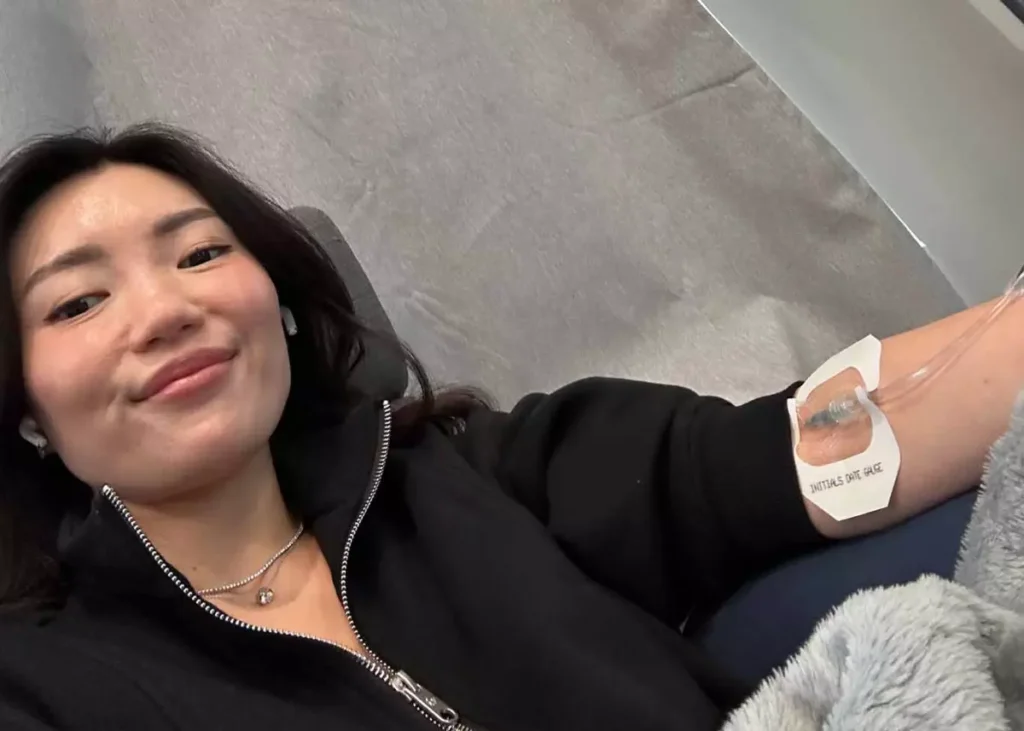
This is the fever that carries wellness trends through Los Angeles, saturating the culture as quickly as a paper napkin dropped into a glass of water. Anecdotes, gossip, and whispers of who’s doing what and getting it from where pepper nearly every interaction. You hear about an “NAD infusion” at a friend’s 40th birthday dinner. You open TikTok and an MD influencer explains “mitochondrial boosting” in under 30 seconds. A mom at drop-off credits her new “peptide stack” for bouncing back after her third baby. You see Hailey Bieber and Kendall Jenner hooked up to NAD IVs on Hulu’s The Kardashians, and suddenly it all feels inevitable, like the science is settled, the efficacy proven when in reality it’s still nascent and, to some degree, uncertain.
What Is NAD?
Nicotinamide adenine dinucleotide (NAD for short) is one of the most important molecules in the body, according to Dr. Chris Rinsch, a longtime mitochondrial researcher and co-founder and president of Swiss biotech company Amazentis.
“Every time you eat, NAD helps turn nutrients into ATP; the energy that powers everything from your muscles to your brain,” he explained to me. NAD also helps regulate key pathways that maintain mitochondrial health. Without sufficient NAD, cells can’t function optimally. Research shows that NAD levels decline with age, dropping significantly by midlife, especially in women, whose hormonal fluctuations throughout perimenopause and menopause may accelerate that decline.
NAD Is Still So New
Relative to other well-established health discoveries like vitamin C, whose scurvy-preventing power was demonstrated in the 18th century, according to research published in The Royal Society, or creatine, first described in the 19th century, nicotinamide adenine dinucleotide is comparatively recent. NAD was discovered in the early 20th century by Arthur Harden and William John Young while studying alcoholic fermentation. The pair identified it as a heat-stable “coferment” required for yeast to convert sugar into alcohol.
Published studies highlight that over the course of the 20th century, scientists gradually expanded their understanding of NAD from identifying its vitamin precursors in 1938 to mapping key enzymes involved in NAD biosynthesis over the following decades.
Experts Can’t Agree
When I asked Leonard Guarente about NAD injections and IVs, his response was straightforward: he’s not a fan of either. “You want to replenish what’s lost with aging,” he said. “You don’t want artificially high levels when you don’t understand the consequences.” That’s why Guarente, along with his co-founder and CEO, Eric Marcotulli, of the NAD supplement brand Elysium, believes oral supplementation makes the most sense.
“NAD belongs in cells, not in the bloodstream,” Guarente explained. “And NAD itself doesn’t efficiently enter cells. That’s why we focus on precursors like NR and NMN. Cells can convert those into NAD.”
RELATED: Why Eating Less Isn’t Helping You Lose Weight Anymore
The goal, he emphasized, isn’t excess but restoration. “Flooding the bloodstream can trigger immune reactions. Burning sensations. People have unpleasant experiences, and there’s no evidence of sustained intracellular benefit.” Their advocacy centers on modest increases supported by thoughtful human clinical trials, not dramatic delivery methods.
In real-world clinical settings, however, some physicians see things differently, though not uncritically.
WHY Is It so Hard to Know What to Believe?
Historically, discoveries like NAD and its link to aging would take decades to move through rigorous, double-blind, placebo-controlled human trials before entering the mainstream consciousness. That slow march defined medical innovation for more than a century. Today, wellness trends often outpace the research. In the age of longevity bros, wellness influencers, and MD content creators, early-stage science is tested publicly, shared anecdotally, and amplified online at wildfire speed, often faster than medical professionals can contextualize or caution against it.
My Experience With NAD
And yes, I’m guilty of contributing to the NAD fever. After that first conversation at drop-off, I started looking into NAD+. Like any rabbit hole, once you begin digging, you quickly find yourself immersed. I asked friends. Talked about it on Instagram.
My online community, many of whom move in elite circles, started responding. One told me her billionaire boss had been injecting NAD at home for years. A Brazilian supermodel DM’d me that she’s a longtime fan. An Indian mega-influencer said he gets NR IVs between Milan and Paris fashion weeks. Once I started asking, the stories poured in.